A backup copy of Eduardo Kac's Adsum will fly to the Moon aboard the Griffin lander. Launch is targeted no earlier than November 2026.


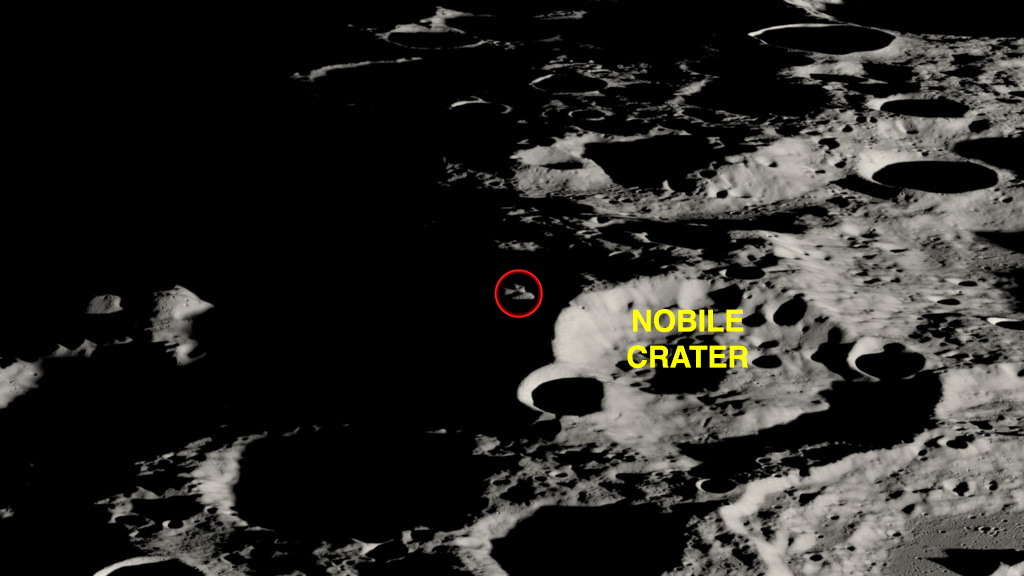
A backup copy of Kac's Adsum is manifested onboard the Griffin lunar lander via Astrobotic's MoonBox payload. Griffin is scheduled to land in the Nobile region near the lunar south pole (see below). Credit: Kac Studio.

A backup copy of Kac's Adsum is manifested onboard the Griffin lunar lander, which is scheduled to fly to the Moon NET November 2026. Credit: Kac Studio.

A backup copy of Kac's Adsum will fly to the Moon's surface inside this cylindrical payload. The photo, taken in May 2026, shows the payload being integrated aboard Griffin-1's V3 panel and securely attached to the spacecraft. Credit: Astrobotic.

A backup copy of Kac's Adsum rests within a honeycomb structure shielded by aluminum, carbon fiber, and a solar panel. It will ride through the vacuum of space, before arriving at its lunar destination. Credit: Astrobotic.

With the succesful landing of Griffin in the Nobile region near the lunar south pole, expected Q4 2026, there will be two copies of Kac's Adsum on the Moon. Blue Ghost, which included Adsum, landed at Mare Crisium on March 2, 2025. Credit: Kac Studio.

A view of the Griffin landing site next to Nobile Crater, near the Moon’s South Pole. Credit: Kac Studio based on an image captured by the Lunar Reconnaissance Orbiter. Credit of the source image: NASA’s Scientific Visualization Studio; NASA/GSFC/Arizona State University.

On August 31, 2026, Griffin Mission One (Griffin-1) was photographed (above) as it was transported toward the 25-Foot Space Simulator at JPL. NASA explained that the yellow-striped structure atop Griffin was a stand-in for Astrolab’s FLIP rover, rather than the actual rover. On October 13, 2026, Voyager Technologies announced that Griffin-1, the company’s infrastructure-class lunar lander, successfully completed acceptance testing, a critical milestone on the path to its targeted launch to the Moon in late 2026. Griffin-1 subsequently returned to Voyager’s Lunar Systems headquarters in Pittsburgh (formerly Astrobotic), where the team will complete final preparations ahead of shipment to Cape Canaveral, Florida for launch. The red arrow indicates the location of the backup version of Eduardo Kac's Adsum. Credit: Voyager/JPL.

On June 15, 2026, Astrobotic unveiled its Griffin Mission One (Griffin-1) lunar lander, recently designated by NASA as Moon Base II. The spacecraft is completing final integration activities and is scheduled to launch in late 2026. Credit: Astrobotic.

A render of the Griffin lunar lander on the Moon. Credit: Astrobotic.


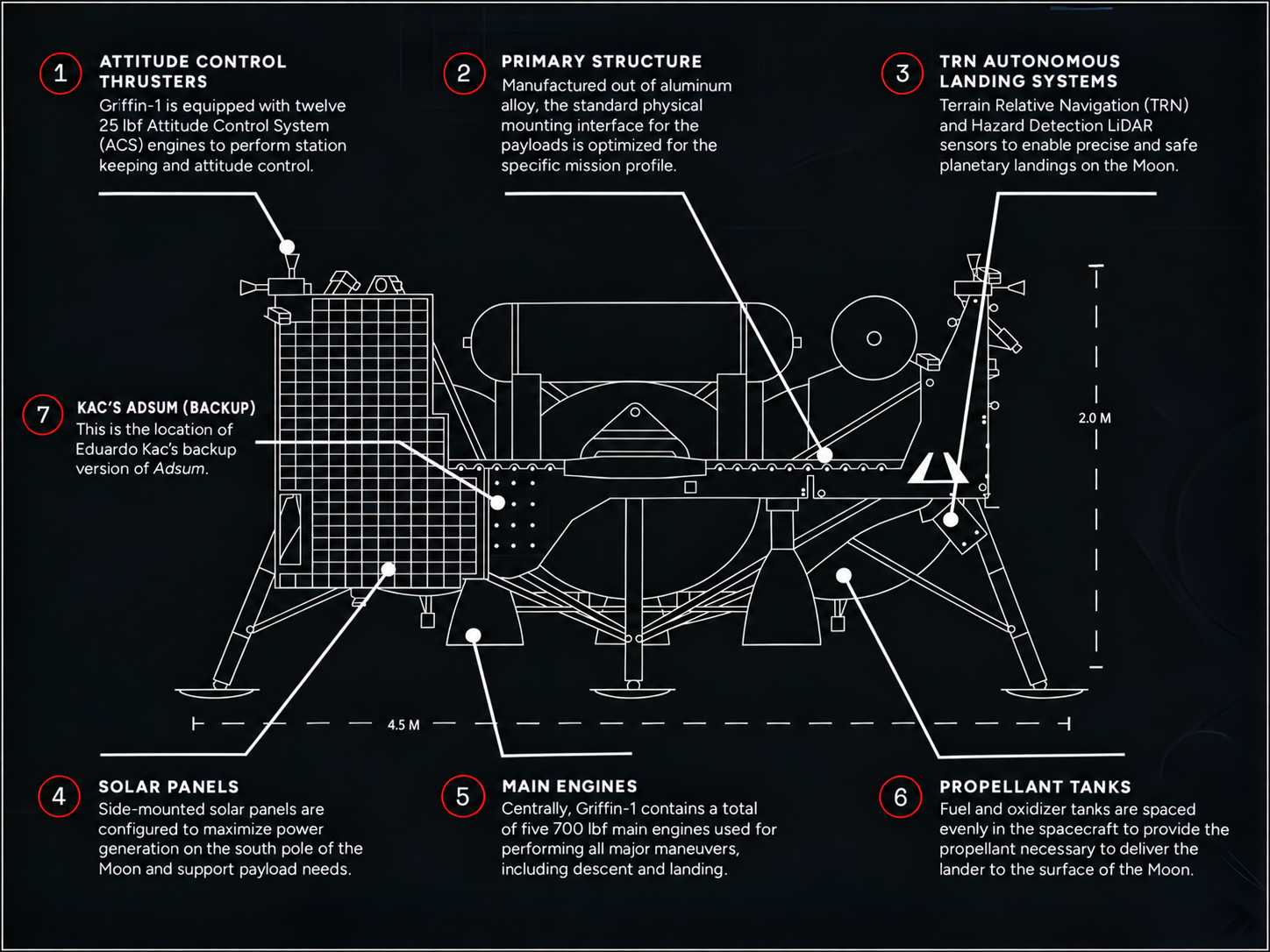
Diagram of the Griffin lunar lander. Credit: Astrobotic.


Griffin “is the first infrastructure-class lander going to the surface of the moon," Astrobotic CEO John Thornton said on June 15, 2026, during its unveiling. "This lander will be part of the cornerstone of building the moon base on the surface of the moon.” NASA chose Astrobotic's Griffin vehicle to be the lander for its Moon Base II mission, part of the first phase of the agency's efforts to establish a permanent lunar outpost. Astrobotic (renamed Voyager Lunar Systems in July 2026) is targeting November 2026 to launch Griffin Mission One (Griffin-1), which will lift off on a SpaceX Falcon Heavy rocket.