Experience 1
Ornitorrinco
1990
Back to Ornitorrinco Chronology
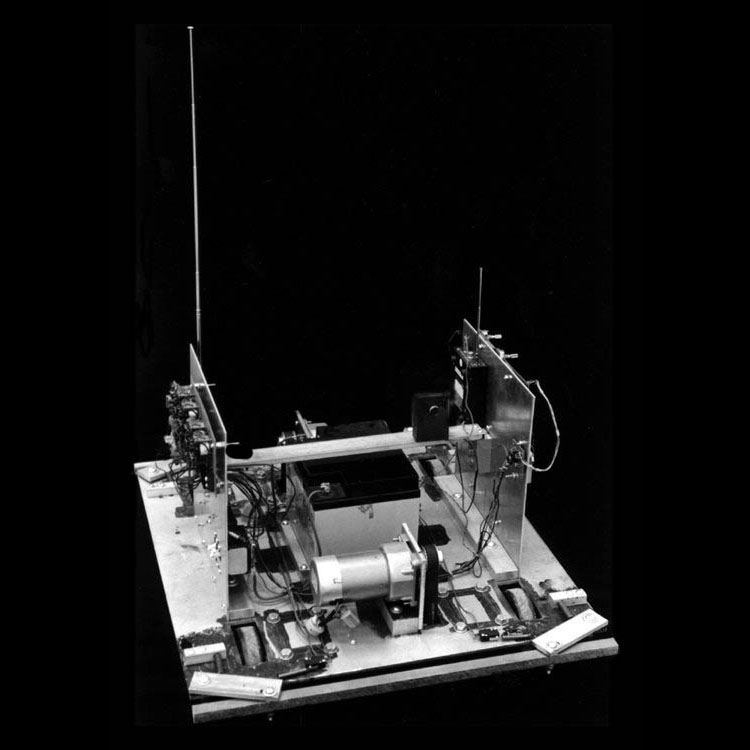
Ornitorrinco: Exploring Telepresence and Remote Sensing
Written in 1990 and originally published in Leonardo, Vol. 24, No.2, 1991, p. 233.
Ornitorrinco ("Platypus", in Portuguese) is a project that explores remote sensing, improvisation and teleoperation as elements of the work. Materially speaking, the project is composed of two telephone lines, four telephone sets, a one-eyed robotic creature (which gives the project its name), a transcoder, and two modems. The piece was developed throughout 1989 in collaboration with Edward Bennett, Technical Assistantat the Electronics Department of The School of The Art Institute of Chicago,and should be understood not as an event, but as a project which is intended to generate new situations each time it is experienced.
Here is the basic structure: in one location, the artist has a telephone with tone (rather than pulse) service. He will use the sounds produced by pushing the numbers on the dial keypad to control Ornitorrinco's motion in a distant place. The artist also has a monitor and a modem (to receive slow scan video stills every eight seconds). In another location, where Ornitorrinco actually is, another artist (or group of artists) prepares a complex environment where Ornitorrinco moves around. Ornitorrinco receives its commands via radio transmission from the transcoder, which is hooked up to the first telephone, and sends video signals via radio to a receiver. The receiver is hooked up to a modem, which transmits the video stills over the second telephone line back to the artist in the first location. Without previous information about the environment, the artist only sees what Ornitorrinco "sees", and controls its movement by pushing the numbers on the dial keypad of the telephone unit. Each number is a code: 1, "move forward to the left"; 2, "straight ahead"; 3, "forward to the right"; 7, "backwards to the left"; 8, "straight backwards"; 9, "backwards to the right"; and any other key, "stop".
Ornitorrinco was experienced for the first time on January 11, 1990, in a link between Rio de Janeiro, Brasil, and Chicago. I was in Rio and Edward Bennett in The School of The Art Institute of Chicago, where he arranged an environment at the Electronics Department.
In Ornitorrinco, the enigmatic idea of 'telekinesis' is embodied in electric and electronic parts, to unveil new paths for telecommunications as an art form beyond the exchange of images. This project is meant to express some of the possibilities of an outreaching vision, in particular, and an extended body, in general, as a consequence of the cultural impact of telecommunication systems.