|
|
TELEPRESENCE ART
Traditionally, telecommunications has
involved the transmission, reception, and
exchange of sound, images, and text. But
in the last fifteen years it has acquired
an altogether new dimension: telepresence,
or the ability to produce action at a
distance. Connecting robots to telecom
networks enables those networks to act as
vehicles for remote agency; artworks that
use this technology explore the drama of
distance, that is, they investigate the
implications of being present in one space
while simultaneously exerting perceptible
physical influence in another.
Telepresence
art preceded the development
of the Web, but now it is coevolving with
it, as exemplified by the work
of artists such as Ken Goldberg ( www.ken.goldberg.net
) and ( Eric Paulos www.eiu.org
). The Internet offers telepresence both a
broader context and a wider
audience.
 |
|
Vectorial
Elevation, 1999 - 2000
www.alzado.net
Realized on
the Internet and in the sky
above the
Zócalo, or central square, in
Mexico City, Rafael
Lozano-Hemmer's
Vectorial Elevation
enabled viewers to manipulate
the light patterns
created by eighteen
strategically placed
searchlights. The piece's
monumental
scale effectively bridged the
public space of the town square
and the public
cyberspace of the Internet.
|
| |
 |
|
Thundervolt,
1994
www.fourchambers.org
/artown_gc_thundervolt.asp
For this
work, Gene Cooper, an
installation and
performance artist, linked the
electrical system of his body to
that of
the earth. Real-time data
recording lightning strikes
around the United
States were relayed to his
computer in Telluride, Colorado,
via the National
Lightning Detection Network. The
strikes registered onscreen were
translated
into electrical signals,
triggering muscles to twitch in
Cooper's body
through a series of
transcutaneous electro-neuro
stimulators.
|
| |
 |
|
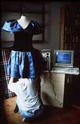
Stock Market
Skirt, 1998
www.bccc.com/nancy/skirt.html
Nancy
Paterson's Stock Market
Skirt played
with the myth that skirt length
is an economic indicator: the
better the
economy, the shorter the skirt.
A party dress made of blue
taffeta and
black velvet was displayed on a
dressmaker's mannequin online,
via Web
cam; its hemline rose and fell
according to up-to-the-minute
data provided
by computers monitoring the
fluctuation of stock prices—thus
making a Wall
Street boom the indisputable
cause of the micromini.
|
| |
 |
|
Bowling
Alley, 1995 - 96
bowlingalley.walkerart.org
Shu Lea
Cheang's installation spanned
not only the
Web but two "real world" sites—a
gallery in the Walker Art
Center, Minneapolis,
and a bowling alley several
miles away. The actions of
participating bowlers
at the alley controlled an
enormous video display in the
museum on which
were projected pictures of the
bowlers (friends of the artist)
and text
from their earlier e-mail
correspondence with her. The
images changed according
to the velocity of the ball and
its course down the lane—a
strike for populist
art?
|
| |
 |
|
Bump, 1997
- 2000
www.bump.at
For Bump,
the Austro-Hungarian artist
collective
Association Creation virtually
linked two footbridges made of
wooden boards—one
in Linz and one in Budapest.
When a person stepped onto the
bridge in Linz,
his or her weight caused the
corresponding plank to rise
about a centimeter
in Budapest, and vice versa, by
means of a data line connecting
pneumatic
pistons on both ends. This
remote force-feedback loop
created a dynamic
form of communication, inviting
pedestrians to make an
impression miles
away with a single, everyday
movement.
|
| |
 |
|
Light on the
Net, 1996
light.softopia.pref.gifu.jp
In Masaki
Fujihata's simple Web interface,
a grid
depicting forty-nine tiny
lightbulbs, viewers can click on
the bulbs to
turn their real counterparts on
and off in the lobby of a
Japanese office
building. This whimsical work
conflates object (bulbs) and
information
(light data) and gives you
credit for your work—switch on a
light and your
computer's ID appears under
"Recent 10 Accesses."
|
| |
|
|
|